Stretchable complementary transistors and circuits
Problem. Dexterous hands of future robotics demand high-density sensing and edge computing on soft skin. However, complementary stretchable transistors with high density and fast speed are lacking, hindering the development of advanced electronic skin for high-performance robots.
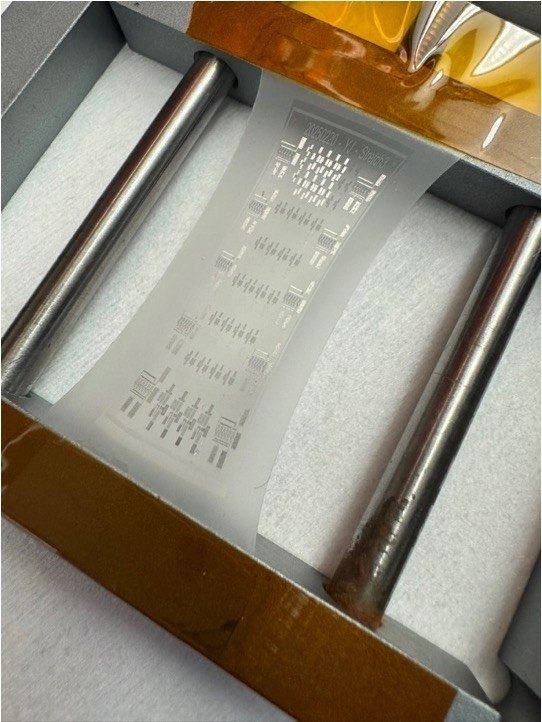
How we developed the project. This work introduced a fabrication process for complementary stretchable transistors and circuits. We transformed it into a versatile platform that supports multiple channel materials and can be achieved using all off-the-shelf commercial materials. Additionally, it can be fabricated in less than 24 hours, a turnover rate more than five times faster than previous generations.
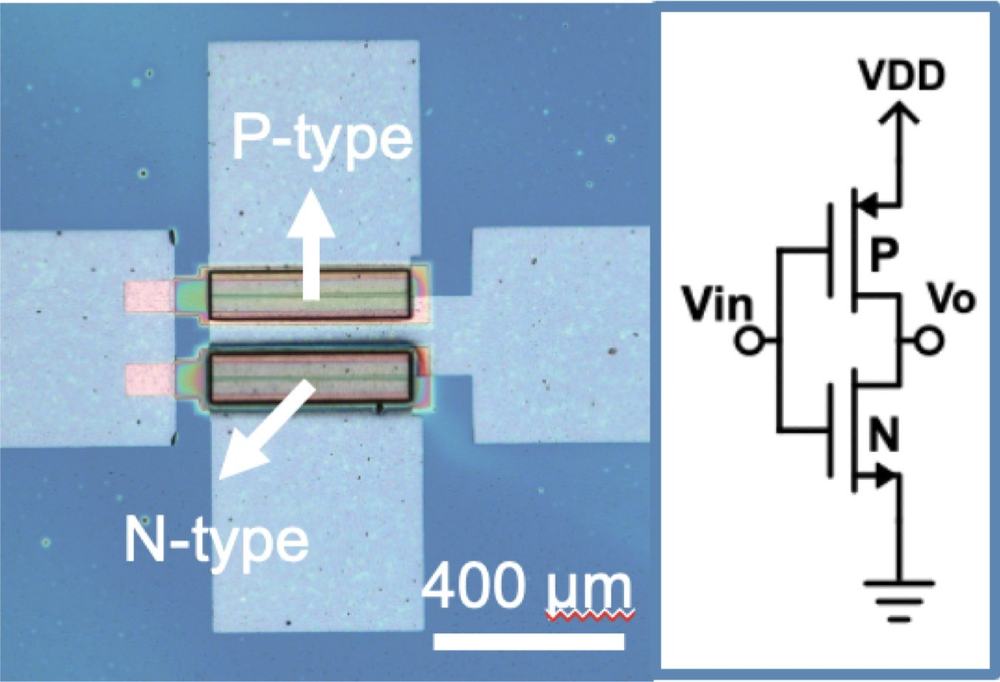
Result. The platform achieved 4-inch-scale fabrication, a transistor density of 55,000 OFETs per cm², channel lengths down to 2 micrometers, and low-voltage 5 V operation. It also demonstrated stretchable complementary inverters, amplifiers, and ring oscillators in the kHz range, including a 3 kHz complementary ring oscillator and a stretchable neuron-style circuit whose output frequency responds to input current.
Why it matters. A soft-electronics lab can now test new polymer semiconductors and circuit designs through a faster and more scalable process. This is crucial for future tactile skins, wearable biomedical devices, and soft robots, which require dense, reliable, and low-power skin-like circuits.