A bio-sensor that stays accurate over time
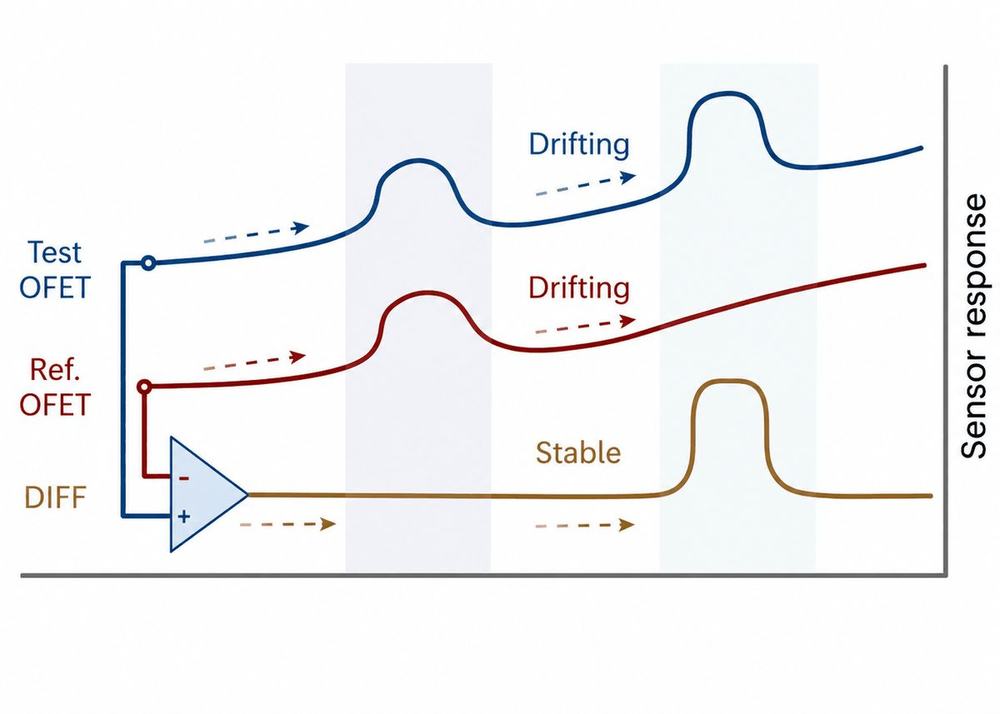
Problem. Wearable biosensors measure tiny chemical signals while sitting on a moving, sweating, warming human body. Temperature, stretching, bias stress, moisture, and sample changes can all shift the electrical signal by more than the biomarker itself. In practical terms, the sensor can look like it is detecting chemistry when it is really detecting drift.
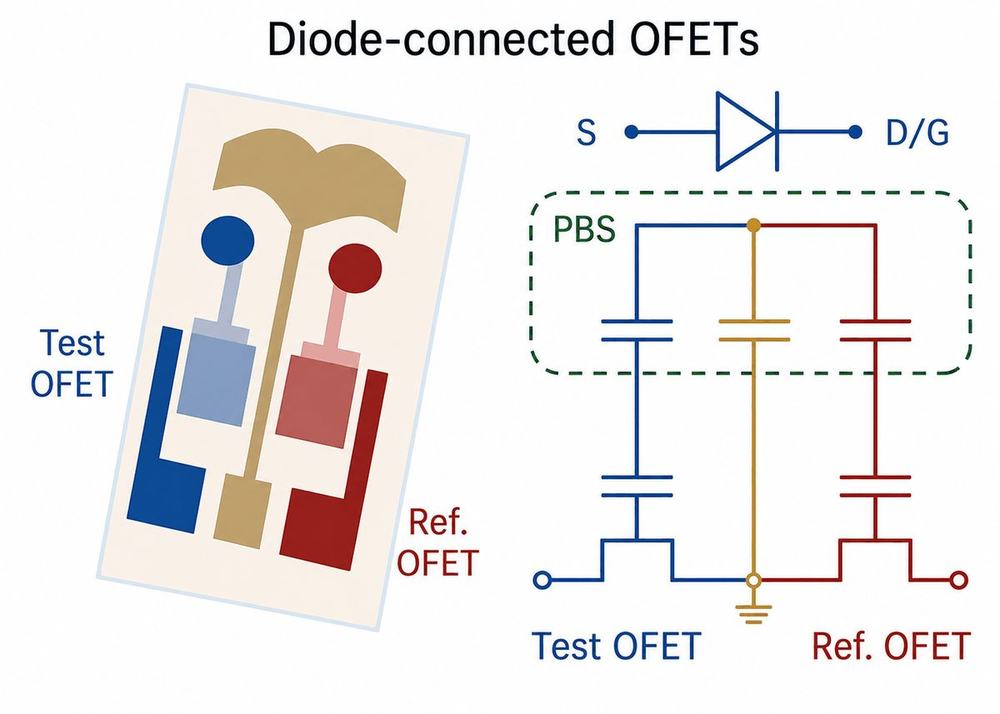
What we did. The paper introduced a differential sensor architecture based on a pair of stretchable organic field-effect transistors. One transistor is connected to the target chemistry, while a matched reference transistor experiences the same environment without the target response. By using diode-connected OFET pairs and subtracting the two signals, the system removes shared drift sources while preserving the chemical signal.
Result. The platform reduced signal distortion by up to two orders of magnitude compared with a conventional unconnected OFET approach. It worked across mechanical strain, compression, temperature changes, and bias stress, and it was demonstrated with cortisol, glucose, and sodium sensing. The work also included a hybrid wearable system with soft sensors, a flexible circuit board, wireless communication, and smartphone readout.